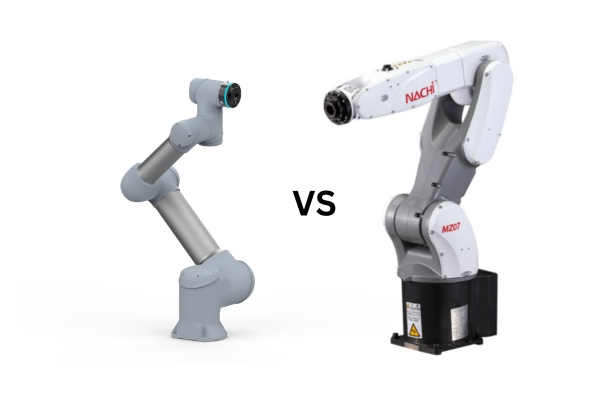
Robotics is no longer the exclusive domain of large automotive manufacturers. In 2025, Malaysian SME manufacturers are deploying robots across electronics assembly, food packaging, plastics, and metal fabrication. But the first question is always: should we use a cobot or a traditional industrial robot?
The answer depends on your specific production requirements, budget, available floor space, and how much you value flexibility versus raw speed. This guide breaks down both options clearly so you can make the right investment decision for your factory.
A collaborative robot (cobot) is designed from the ground up to work alongside human operators safely. Unlike traditional industrial robots that operate behind safety fencing in isolated cells, cobots use built-in force-torque sensors and advanced motion control to detect human contact and stop immediately before causing injury.
Cobots are typically lighter, slower, and have lower payload capacity than their industrial counterparts — but they are far easier to programme, redeploy, and integrate into existing production without major facility changes.
Popular cobot brands used in Malaysia include Universal Robots (UR3e, UR5e, UR10e), OMRON TM Series, FANUC CRX, ABB GoFa, and KUKA LBR iisy.
A traditional industrial robot is a high-speed, high-payload machine built for maximum throughput in a fixed, automated cell. It operates at speeds and forces that would injure a human worker on contact, requiring physical safety guarding — fencing, light curtains, and emergency stops — to protect people in the vicinity.
Industrial robots excel in applications requiring extreme precision, very high cycle speeds, and heavy payloads. They have been the backbone of automotive and electronics manufacturing for decades.
| Factor | Cobot | Industrial Robot |
|---|---|---|
| Safety Fencing Required | No (typically) | Yes |
| Payload Capacity | 3 kg – 35 kg | Up to 2,300 kg |
| Operating Speed | Lower (for safety) | Very high |
| Programming Difficulty | Easy — hand-guided teaching | Complex — specialist programmer required |
| Redeployment Flexibility | High — move and reprogramme easily | Low — fixed cell installation |
| Installation Cost | Lower (no guarding) | Higher (guarding, integration) |
| Floor Space Required | Small | Large (cell + safety zone) |
| Typical Cycle Time | Moderate | Very fast |
| ROI Timeline | 6 – 18 months | 18 – 36 months |
| Best For | Mixed production, SMEs, light assembly | High-volume, fixed-process, heavy loads |
Traditional industrial robots require substantial investment in safety infrastructure — fencing, interlocked gates, light curtains, and safety PLCs. A cobot eliminates most of this, reducing installation cost and floor space requirements significantly. For a Malaysian SME with limited factory space, this is often the deciding factor.
Leading cobots use intuitive hand-guiding — literally moving the robot arm through the desired path while it records the trajectory. A trained operator can reprogramme a cobot for a new task in 30 minutes without writing a single line of code. This is transformative for factories running small batches of multiple product variants.
Many production tasks benefit from a human-robot team rather than full automation. A cobot can handle the heavy lifting, repetitive screwdriving, or precise placement, while a human worker handles the judgement-based tasks like quality checking or part orientation. Together they outperform either working alone.
Despite the cobot revolution, traditional industrial robots remain the right choice for specific applications:
Most Malaysian SMEs should start with a cobot. The lower total cost of ownership, flexibility, and ease of reprogramming make it the most practical entry point into robotics. Industrial robots make sense once you have identified a high-volume, fixed-process application that justifies the investment in guarding and integration.
At Aliran Tenaga Teknologi Sdn. Bhd., our robotic solutions team helps Malaysian manufacturers select, integrate, and commission the right robotic system for their specific application. We work with both cobot and traditional industrial robot platforms and design the complete system — including end-of-arm tooling, safety systems, PLC integration, and operator training.
Our engineers will assess your production process and recommend the right robotic system for your factory and budget.
Get a Free Robotics Consultation →