12 August 2026 • Aliran Tenaga Engineering Team
Standard conveyors are wonderful things. They are cheaper, faster to get, and for a great many jobs they are exactly the right answer. But every factory eventually meets a situation where the off-the-shelf option simply does not fit — an awkward product, a cramped floor, a process that needs the line to do something specific — and forcing a standard unit into that gap causes more problems than it solves.
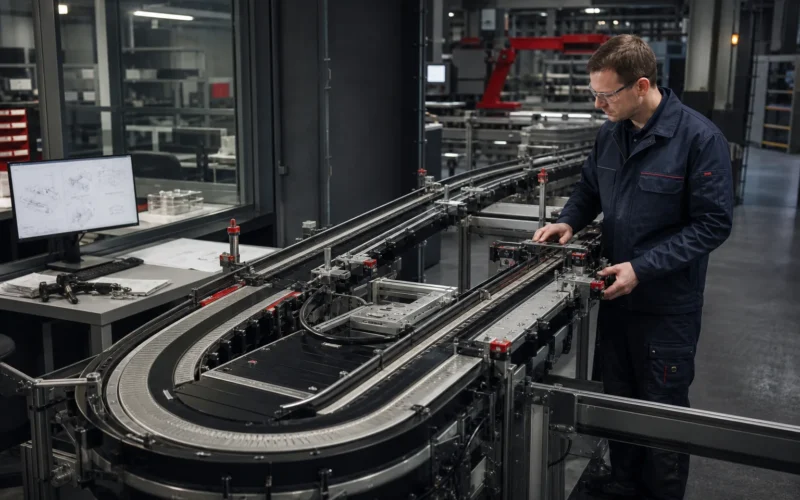
That is where custom conveyor design comes in. It is not about paying more for the sake of it; it is about building a line that fits your product, your floor and your process exactly, so it runs faster, jams less and lasts longer. This article explains when standard is not enough, why forcing a standard unit quietly costs you more, how custom design actually works, and why having one accountable team behind it matters.
Most factories reach for a standard conveyor first, and they are right to. But there are clear signs that off-the-shelf will not serve you well, and recognising them early saves a lot of wasted money:
When one or more of these is true, a standard conveyor becomes a compromise from day one — and you live with that compromise every shift. A custom design starts from your actual requirements instead of forcing your requirements to bend around a catalogue product.
The instinct to save money with a standard conveyor is understandable, but when the fit is wrong it usually costs more, not less — the cost is just hidden. It does not appear on the invoice; it shows up quietly, month after month, in the running of the line.
A standard unit squeezed into an awkward space often creates a bottleneck, capping how fast the whole line can go. It may leave you with manual handovers — someone lifting or shifting product where the line should just flow — which adds labour and slows everything down. It can waste floor space that a purpose-built layout would have used efficiently. And it may jam repeatedly at the points where it was never designed to do the job you are asking of it, costing you downtime and frustration.
Add all of that up over five or ten years, and the “cheaper” standard conveyor frequently turns out to be the more expensive choice. A custom line that fits properly runs at full speed, needs less manual help, uses your space well, and jams far less — and those daily savings quietly repay the higher upfront cost many times over.
Custom does not mean complicated or slow. A good custom process is actually very structured, and it starts with understanding rather than building:
The key difference from buying off the shelf is that the design starts with your requirements, not with a catalogue. You are not choosing the closest available product and hoping it works — you are getting a line built around what you actually need. That is what makes a custom line fit like it belongs, because it does.
A simple example makes the point. Imagine a factory with a low mezzanine, a pillar right in the middle of the floor, and a product that has to climb to the upper level, turn ninety degrees around that pillar, and hand off to a packing bench. No standard conveyor in a catalogue fits that path. Forced to use one, the factory ends up with staff manually carrying product around the pillar and up the steps — slow, tiring and exactly the bottleneck they were trying to remove. A custom line, by contrast, is designed to weave around the pillar, climb at the right point and deliver straight to the bench, so the product flows the whole way with nobody touching it. The awkward floor stops being a problem and becomes just another thing the design works around.
One of the biggest advantages of a proper custom design is that the line can be modelled and tested on screen before a single part is cut. This step is easy to overlook, but it is where a lot of risk disappears.
Simulation lets the engineer prove the design will hit your target throughput, watch how product flows through every merge, curve and incline, and spot bottlenecks or jam points while they are still just lines on a screen. Fixing a problem in the design stage costs nothing; fixing the same problem after the line is built and running costs real money and downtime. When you commission a custom line, ask to see it simulated — a good engineer will happily show you the flow modelled, because it proves the design works before you have committed to building it. It also gives you confidence that the number you were promised — the units or pallets per hour — is real and not just optimistic.
A custom conveyor line touches design, fabrication, installation and often electrical and control work. The single biggest thing that determines whether the project goes smoothly is whether one team is accountable for all of it, or whether it is split across several companies who can each blame the others when something does not line up.
When one team designs, builds, installs and maintains the line, the design is made to be built, the build matches the design, and the installation is done by people who understand the whole system. If something needs adjusting, there is one number to call and no finger-pointing. And when the line needs service or a spare part years later, the same team already knows it inside out. That continuity is worth a great deal — it is the difference between a line that is supported for its whole life and one that becomes an orphan the moment it is handed over. For a custom system in particular, where the line is unique to you, having its makers on call is exactly the reassurance you want.
Is a custom conveyor much more expensive than a standard one?
The upfront price is usually higher, but when a standard unit does not fit properly, the custom line often costs less over its life by avoiding bottlenecks, manual handling, wasted space and repeated jams.
Does custom design take a long time?
Not necessarily. A good custom process is structured and efficient, and the design and simulation stages actually reduce the risk of delays later by getting the line right before it is built.
Can a custom line be built to expand later?
Yes — this is one of the main reasons to go custom. The line can be designed in a modular way with spare capacity so you add sections later instead of replacing it.
What if I only need part of my line customised?
That is very common. A line can mix standard sections where they fit with custom sections where they are needed, giving you the best of both.
Can you integrate a custom conveyor with my existing machines?
Yes. A key part of custom design is handling the hand-offs to your existing equipment, robots or systems so everything works together smoothly.
At Aliran Tenaga Technology, we design, build, install and maintain industrial systems across Malaysia — all under one roof from our base in Subang Jaya, Selangor. With over 15 years of hands-on engineering, an in-house design and fabrication team, and rapid on-site support, we are one accountable partner from first idea to running line. Tell us what you need and our team replies within 24 hours with a clear, no-obligation quote.
👉 See how we can help or Request a Free Quote today.
Related reading: