6 September 2026 • Aliran Tenaga Engineering Team
Go to the end of almost any production line in Malaysia and you will find the same scene: one or two workers lifting finished cartons or bags onto a pallet, hour after hour, shift after shift. It is heavy, it is repetitive, and it is one of the most reliable ways to give your staff a bad back. It is also, quietly, one of the hardest positions to keep filled, because nobody enjoys doing it and turnover is high.
Robotic palletising takes that job off human shoulders. A robot stacks your finished goods onto pallets, to a neat and consistent pattern, at a steady pace, around the clock, without complaint and without injury. For a lot of Malaysian factories it is the single clearest, fastest-paying piece of automation they can invest in, precisely because the task is so well defined and so unpleasant to do by hand.
This guide explains how robotic palletising actually works, the different types available, where it fits in your line, what it costs and how the return stacks up, and how to choose a system that suits your operation rather than one that looks impressive in a brochure.
Not every part of a factory is a good automation candidate. Palletising almost always is, for a few reasons that reinforce each other.
It is repetitive and physical, which is exactly what machines do better than people. It is a leading cause of manual-handling injuries, which under Malaysian workplace safety expectations overseen by DOSH is a genuine liability as well as a human cost. It runs at the end of the line, so it is naturally isolated and easy to automate without disturbing the rest of your process. And the output is uniform: the same cartons, bags or boxes, stacked to a pattern, which is the ideal job for a robot to learn once and repeat perfectly.
Put simply, palletising is heavy, injury-prone, hard to staff, and mechanically simple to hand to a robot. That combination is why so many automation journeys in Malaysian factories start exactly here.
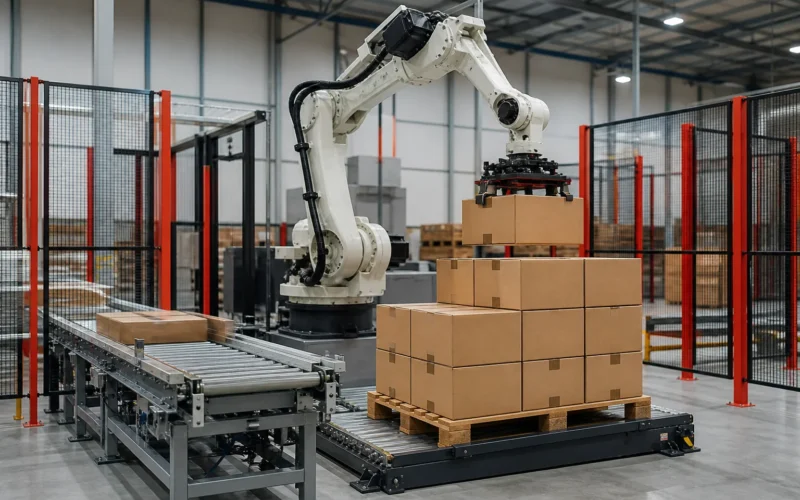
A robotic palletising cell is not just a robot arm. It is a small system, and understanding the parts helps you evaluate any quote you are given.
The infeed. Finished products arrive from your production line, usually on a conveyor. Often the products are labelled, checked and oriented on the way in, so the robot receives them in a known, consistent position. A good infeed design is half the battle; a robot fed inconsistent products will struggle no matter how good it is.
The robot. An industrial robot arm, or in some cases a collaborative robot, does the lifting and placing. It is programmed with the pallet patterns for each product, so it knows exactly where each carton goes, layer by layer, to build a stable, tightly interlocked stack.
The gripper (end-of-arm tooling). This is the business end, the tool that actually grabs the product. It might be a vacuum head for boxes, a clamp for bags, or a specialised gripper for awkward shapes. Matching the gripper to your product is one of the most important design decisions, and getting it wrong is a common reason cheap systems disappoint.
The pallet handling. Empty pallets are fed in and full pallets are moved out, which can be manual with a pallet jack, or automated with pallet conveyors and dispensers for a fully hands-off line.
The controls and safety. A PLC coordinates the whole cell, and guarding, light curtains and emergency stops keep people safe around a moving robot. The control and safety layer is not an optional extra; it is what makes the cell safe and reliable to run every day.
When these parts are designed together as one system, palletising becomes genuinely hands-off. When they are bought piecemeal, the gaps between them are where the problems live.
“Robotic palletising” is one option among a few, and the right choice depends on your speed, product mix and space.
Conventional (layer) palletisers. These are large, dedicated machines that build a full layer of product and then lower it onto the pallet. They are very fast and suit high-speed, single-product lines, but they are big, less flexible, and expensive to change over between products.
Robotic arm palletisers. A robot arm picks and places products individually or in small groups. They are far more flexible than layer palletisers, handle multiple products and pallet patterns easily, take up less space, and can often serve more than one line. For the varied product mixes typical of Malaysian SMEs, a robotic arm is usually the sweet spot, which is why it is the most common choice.
Collaborative (cobot) palletisers. A smaller collaborative robot works at lower speed, often without heavy guarding, in a compact footprint. Cobot palletisers suit lower-volume lines and tight spaces where a full industrial cell would be overkill. They are a genuinely useful option for smaller operations, with the trade-off of slower throughput.
A capable integrator will not push one type; they will match the solution to your actual throughput, product range and floor space. If a supplier recommends a system before understanding those three things, be cautious.
Robotic palletising has a reputation as a fast-payback investment, and that reputation is earned. The return builds from several directions.
Labour. The most direct saving. Palletising is often a multi-shift, multi-person task, and it is one of the hardest roles to keep staffed. A robot removes that dependency and lets you redeploy people to higher-value work.
Injury and safety. Manual palletising is a major source of back and musculoskeletal injuries. Removing it protects your people and reduces the very real costs, financial and human, that come with workplace injuries.
Consistency and stability. A robot builds the same tight, well-interlocked pallet every time. That means fewer collapsed or leaning pallets, less product damage in transit, and better use of each pallet and each truck.
Throughput and uptime. A robot runs at a steady pace through the whole shift and can run through breaks and into extra shifts when you need it. It does not slow down at 3 a.m., which makes your output predictable.
Flexibility for growth. A robotic cell can be reprogrammed for new products and patterns, so it grows with your product range rather than locking you into today’s mix.
Because the labour and safety savings are so clear and the task is so contained, palletising is one of the few automation projects where the payback is genuinely easy to calculate. Count the shifts and people currently doing it, add the cost of turnover and injuries, and compare that to the system over a few years. For many Malaysian factories, the sums are compelling.
The cost of a palletising cell depends on speed, product complexity, gripper design and how much of the pallet handling you automate. A compact cobot cell is a modest investment; a high-speed industrial cell feeding multiple lines with automated pallet handling is a larger one. As with any automation, the honest answer to “what does it cost” is “let us look at your line”, because scope drives everything.
What many operators miss is that a palletising robot is exactly the kind of productivity-raising investment that Malaysian government schemes are designed to support. A matching grant such as the Smart Automation Grant, an Investment Tax Allowance on the capital expenditure, or support under the Industry4WRD framework can meaningfully improve the economics. We cover this in detail in our guide to the Smart Automation Grant in Malaysia, and the key point is to explore the funding before you commit, not after. A partner who prepares proper technical documentation makes those applications far easier.
A palletising robot on its own is useful. Tied into the rest of your line, it becomes part of a genuinely hands-off flow. Products come off production on a conveyor, are checked and oriented, are stacked by the robot, and the full pallet moves on to a pallet conveyor and stretch wrapper, and out to dispatch, with barely a human hand involved.
This is where the value of a single, accountable integrator really shows. The hand-off points, the conveyor feeding the robot, the robot feeding the wrapper, are exactly where a piecemeal, multi-vendor project jams. When one team designs the whole flow, those transitions are engineered to work together. If you are thinking beyond palletising to the wider picture, our overview of warehouse automation in Malaysia shows how these pieces fit into a complete operation.
The success of a palletising project rests less on the brand of robot and more on the quality of the system design around it. When you evaluate a supplier, look for a few things. Do they take the time to understand your product, throughput and space before recommending a solution? Can they design the right gripper for your specific product, and show you it working? Do they handle the conveyors, controls and safety as part of the package, or just drop in a robot and leave the integration to you? And crucially, can they support and service the cell quickly once it is running, because a palletiser that stops at the end of your line stops your whole dispatch.
There is a strong case for a partner who covers the whole cell, robot, gripper, conveyors, controls and safety, under one roof, because it removes the integration risk that undermines so many robot projects. Aliran Tenaga delivers palletising as part of its robotic solutions, designed and built alongside the conveyors and controls that make it work.
It is worth knowing that the same technology works the other way round. De-palletising, unstacking incoming pallets of raw materials, components or packaging and feeding them onto a line, is just as heavy and repetitive as building pallets, and just as good a candidate for a robot. Many factories that start with palletising at the end of the line later add de-palletising at the start, using the same skills and often the same type of robot. If your goods-in area has people manually breaking down pallet after pallet, it is worth putting on the list.
Palletising projects are usually smooth, but the ones that disappoint tend to make the same errors. The biggest is skimping on the gripper: a cheap, generic gripper that does not truly suit your product will drop items, slow the cycle and frustrate everyone, undoing the whole investment. The second is ignoring the infeed: if the robot is fed inconsistently oriented products, no amount of clever programming fully fixes it, so the conveyor and orientation before the robot matter as much as the robot itself. The third is buying the robot as a standalone box and leaving your team to integrate it with the conveyors, wrapper and controls, which is exactly where the gaps and jams appear. And the fourth is under-scoping the safety: a moving robot needs proper guarding and interlocks, and cutting corners there is neither legal nor wise. A good integrator heads all four off during design, which is why the design conversation matters more than the price on the quote.
Robotic palletising is worth serious consideration if several of these are true: you have people manually stacking cartons or bags at the end of a line; palletising runs across multiple shifts and is hard to staff; you have had back or lifting injuries; your pallets sometimes lean, collapse or get damaged in transit; or you are growing and cannot easily add the people to keep up. The more of those that ring true, the stronger the case. The best way to know for sure is a short assessment: an engineer looks at your product, your speed and your space, and tells you honestly which type of palletising suits, and what the return is likely to look like.
Aliran Tenaga Technology designs, builds, installs and maintains industrial systems across Malaysia, all under one roof from our base in Subang Jaya, Selangor. With over 15 years of hands-on engineering and an in-house design and fabrication team, we deliver robotic palletising as a complete cell, robot, gripper, conveyors and controls, engineered to work together and supported quickly when you need us. One accountable partner, from the first look at your line to the day it is running, and every service call after.
How fast is a robotic palletiser?
It depends on the product and the system, but a robotic arm cell comfortably handles typical end-of-line speeds, and higher-speed options exist for demanding lines. The right speed is matched to your actual throughput during the design stage, so you neither pay for capacity you will not use nor create a bottleneck.
Can one robot palletise different products?
Yes. A key advantage of a robotic arm palletiser is flexibility. It stores multiple pallet patterns and can switch between products, and can often serve more than one line, which suits the varied product mixes common in Malaysian factories.
What is a cobot palletiser, and is it right for me?
A collaborative robot palletiser is a smaller, slower system that works in a compact footprint, often with lighter guarding. It suits lower-volume lines and tight spaces where a full industrial cell would be too much. If your volumes are modest, it can be a cost-effective entry point.
How much floor space does a palletising cell need?
Less than most people expect, especially a robotic arm cell, which serves the pallet build in a compact area. The exact footprint depends on the robot reach, the number of pallet positions and the safety guarding, all of which are set during design.
Can palletising be funded by a grant?
Often, yes. As a clear productivity-raising investment, a palletising robot is the kind of project Malaysian schemes such as the Smart Automation Grant, Investment Tax Allowance and Industry4WRD are designed to support. Confirm current terms with MIDA and MITI, and ask your integrator to help with the documentation.
Will a robot make my pallets more stable?
Yes. A robot builds the same tight, well-interlocked pattern every time, which means fewer leaning or collapsed pallets, less product damage in transit, and better use of each pallet and truck than variable manual stacking.
How long does it take to install a palletising cell?
A standard cell can be designed, built and commissioned in a matter of weeks; a larger, fully integrated cell with automated pallet handling takes longer. A good integrator gives you a clear timeline and, where possible, simulates the cell before building to prove the throughput.
Tell us what you are stacking and how fast, and our team replies within 24 hours with a clear, no-obligation assessment of the right palletising solution. 👉 See our robotic solutions or Request a Free Quote today.