12 September 2026 • Aliran Tenaga Engineering Team
A conveyor looks like one of the simplest machines in a factory: a belt goes round and round and moves things from one end to the other. That simplicity is exactly why so many conveyor problems trace back to one quiet decision made early on, the type of belt. Choose the wrong belt and you get slipping on inclines, product sticking, belts that tear or stretch, hygiene failures on a food line, or a conveyor that needs constant babysitting. Choose the right one and the conveyor just works, year after year, and you forget it is even there.
This guide walks through the main conveyor belt types used in Malaysian factories, what each is good and bad at, how belt construction affects performance, and how to match a belt to your product, your environment and your budget. It is written for the people who actually live with the decision, factory managers, maintenance leads and engineers, not for a catalogue.
The belt is the one part of a conveyor that touches your product on every single cycle, and it is the part that wears. Everything about how the conveyor performs, whether product grips or slips, whether it can climb an incline, whether it survives your washdown routine, whether it copes with heat or oil or sharp edges, comes down to belt material and construction. A frame is a frame; the belt is where the engineering decision lives.
It also drives your running costs. The wrong belt wears out early, jams, damages product, or forces you to run slower than you should. The right belt lasts, runs clean, and lets the line run at full speed. Over a few years, the gap between a well-chosen belt and a poorly chosen one is not small. That is why a serious material handling system is designed around the product first, and the belt is specified to suit it, rather than a standard belt being forced to cope with whatever comes down the line.
Most factory conveyor belts fall into a handful of material families. Here is the honest, practical rundown.
PVC belts. The everyday workhorse. PVC (polyvinyl chloride) belts are affordable, durable and available in many surface textures, which makes them the default for general light-to-medium duty, moving boxes, packaged goods and components in dry conditions. If you have a standard packing or assembly line and no special demands, a PVC belt is usually where the conversation starts.
PU (polyurethane) belts. Cleaner and more hygienic than PVC, PU belts resist oils, fats and cuts better and are easier to keep clean, which makes them a common choice for food handling and any application where hygiene and resistance to grease matter. They cost a little more than PVC and earn it where cleanliness counts.
Rubber belts. The choice for heavier, rougher duty. Rubber belts handle bulk materials, abrasive products and heavier loads, and textured or rough-top rubber gives extra grip for inclines. If you are moving heavy or messy material rather than neat packages, rubber is often the answer.
Modular plastic belts. Instead of one continuous belt, these are built from interlocking plastic modules, like a plastic chain-mail. They are extremely robust, can be repaired module by module rather than replaced whole, handle curves and inclines well, and drain and wash easily, which is why they are so popular in food, beverage and bottling lines. The trade-off is a higher upfront cost and a slightly less smooth surface for very small items.
Wire mesh and metal belts. When heat is the problem, ordinary belts melt, so metal wire-mesh belts are used for ovens, cooling, drying and other high-temperature processes. They also allow air, water or debris to pass through the belt, useful for cooling or draining. They are specialised and priced accordingly.
Fabric and specialist belts. Beyond these, there are fabric-reinforced belts for specific strength needs, and a range of specialist belts for particular jobs. The point is not to memorise them but to know that if your application is unusual, there is very likely a belt engineered for it, and a good integrator will know which.
Belt material is only half the choice; the surface and profile matter just as much, and this is where inclines and awkward products are won or lost.
Smooth belts suit flat, horizontal runs where product simply needs to be carried along. Rough-top or textured belts add grip, which is what you need on an incline so product does not slide back, or for items that would otherwise shift. Cleated belts have raised barriers, cleats, fixed across the belt at intervals, creating pockets that carry product up steep inclines without it tumbling back, essential for elevating loose or bulk items. Sidewall belts add raised edges to contain loose product. Matching the profile to the job is often the difference between a conveyor that works and one that constantly spills or stalls, and it is a detail cheap quotes routinely get wrong.
Underneath the surface, a belt’s construction determines its strength, flexibility and lifespan. You do not need to be an expert, but knowing the vocabulary helps you ask the right questions.
Most belts are built in layers: a top cover that contacts the product, one or more reinforcing plies (often fabric) that give the belt its tensile strength, and a bottom cover that runs on the pulleys and rollers. More plies and thicker covers mean a stronger, more durable belt, but also a stiffer one that needs larger pulleys. The right build is a balance: strong enough for the load and the tension, flexible enough for the pulley sizes, and with a cover suited to the wear it will face. When a belt fails early, the cause is very often a construction that was under-specified for the real duty, a light belt asked to do a heavy job.
The factory environment is as important as the product. A few Malaysian realities come up again and again.
Food, beverage and pharma. These lines demand hygienic, cleanable belts, typically PU or modular plastic, that withstand frequent washdown and meet food-contact expectations. Cutting corners here is a compliance and safety risk, not just a maintenance one.
Wet or washdown areas. Belts and their whole conveyor need to tolerate water and cleaning chemicals without corroding or harbouring bacteria, which points to plastic modular belts and stainless framing.
Heat. Ovens, curing and cooling call for metal or high-temperature belts that will not soften or deform.
Oil, grease and chemicals. PU and certain specialist belts resist these far better than standard PVC, which can swell or degrade.
Abrasive or heavy loads. Rubber and heavily reinforced belts take the punishment that would quickly destroy a light belt.
The lesson is simple: specify the belt for the worst thing your environment throws at it, not the average day.
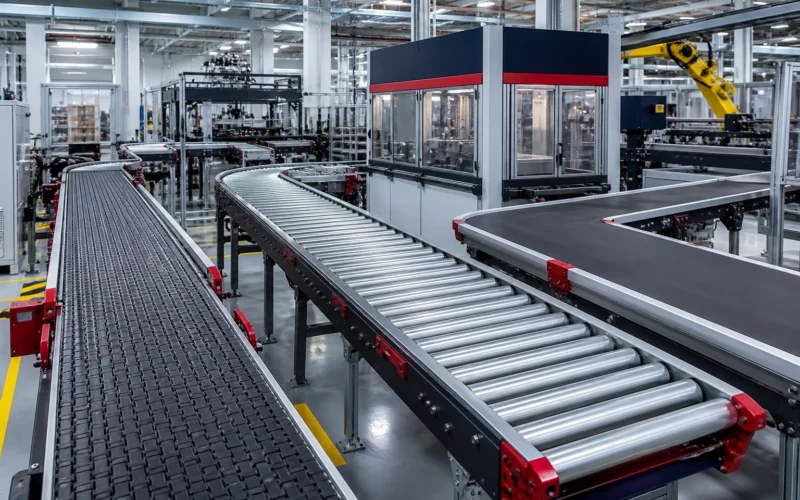
Sometimes the real question is not which belt, but whether a belt is the right conveyor at all. As a rough guide, belt conveyors excel at carrying small, light, irregular or loose items and at inclines, because the continuous surface supports anything. Roller conveyors suit flat-bottomed items like cartons, totes and pallets, and are efficient for accumulation and for heavier unit loads. Many real lines use both, belt where product needs full support, rollers where boxes and pallets move and accumulate. A good integrator picks the right tool for each section rather than forcing one type everywhere, and our dedicated guide compares pallet and roller conveyor systems in more detail.
Most day-to-day conveyor headaches come back to belt choice or setup, and recognising them saves a lot of downtime. Slipping, especially on an incline, usually means the wrong surface, a smooth belt where you needed rough-top or cleats. Product sticking or marking often points to the wrong material for the product, or a belt that is not being cleaned as its material requires. Mistracking, where the belt drifts to one side, is sometimes a tensioning or alignment issue but can also mean a belt that is too stiff or wrongly built for the pulley sizes. Premature wear or tearing is the classic sign of an under-specified belt asked to do heavier duty than it was built for. Fraying edges or cracking can indicate heat, chemical attack or age. When these keep recurring, the fix is rarely to keep replacing the same belt, it is to specify the right belt and set it up properly, which is exactly the kind of thing a proper conveyor supplier gets right at the design stage.
A belt does not work alone. It runs on a frame, is driven by a motor and pulleys, and on any serious line is coordinated by a control system that starts, stops and sequences it alongside everything else. When a conveyor is part of an automated flow, feeding a robotic cell, moving product through a process, or delivering to a packing line, the belt, the drive and the PLC control all have to be designed together. This is why buying a conveyor as a standalone box from a catalogue often disappoints on an integrated line: the belt might be fine in isolation but wrong for how it has to interact with the rest of the system. Designed as part of a whole, the conveyor becomes a reliable link in the chain. Our overview of warehouse automation in Malaysia shows how these pieces come together.
As a rough orientation, not a substitute for proper design, here is how the common belt families line up against typical needs:
| If your priority is… | Start by looking at |
|---|---|
| Low cost, general dry duty | PVC belt |
| Hygiene, oils and grease resistance | PU belt |
| Washdown, food and beverage lines | Modular plastic or PU belt |
| Heavy, abrasive or bulk loads | Rubber belt |
| Climbing steep inclines | Cleated or rough-top belt |
| High temperature (ovens, cooling) | Wire-mesh or metal belt |
Treat this as a starting point for the conversation with your integrator, not a final answer, because the right belt always depends on the specific product, speed and layout as well as the headline priority.
You do not need to become a belt expert to make a good decision; you need to give a good integrator the right information and ask the right questions. Be ready to describe your product (size, weight, shape, whether it is loose or packaged, whether it is greasy, sharp, hot or sticky), your environment (dry, wet, washdown, hot, chemical), your layout (flat, inclined, curved, how long), and your throughput. With those, an experienced supplier can specify the belt material, surface, profile and construction that will actually last. Then ask them why they chose it, a good supplier can explain the choice in plain terms, and be wary of anyone who offers the same standard belt for every job.
Aliran Tenaga Technology designs, builds, installs and maintains conveyor and material handling systems across Malaysia from our base in Subang Jaya, Selangor. With over 15 years of hands-on engineering and an in-house design and fabrication team, we specify and build conveyor systems around your product and environment, the right belt, the right frame, the right drive and the controls to run them, and we support them quickly when you need us. One accountable partner for a conveyor that simply works.
The recurring conveyor-belt mistakes are easy to list and easy to avoid with the right partner. The first is buying on price alone and accepting a generic belt that is not suited to the product or environment, which costs far more in early failures and downtime than it ever saved. The second is ignoring the incline, using a smooth belt where grip or cleats were needed, and then fighting slippage forever. The third is under-specifying construction, putting a light belt on a heavy or high-tension duty, so it stretches, tears or mistrack. The fourth is forgetting hygiene, using a hard-to-clean belt on a food line where a washable PU or modular belt was required. And the fifth is treating the conveyor as a standalone purchase rather than a part of the wider system it has to work within. Each of these is a design decision, which is why the design conversation, not the price on the quote, is what determines whether your conveyor is a quiet asset or a constant nuisance.
What is the most common conveyor belt type?
For general factory use in dry conditions, PVC belts are the most common, because they are affordable, durable and available in many surface textures. They are the usual starting point for standard packing and assembly lines, with other materials chosen when the product or environment demands it.
Which belt is best for a food or beverage line?
Polyurethane (PU) and modular plastic belts are the usual choice, because they are hygienic, resist oils and fats, and withstand frequent washdown. The exact choice depends on the product and cleaning routine, but hard-to-clean belts should be avoided on food-contact lines.
What belt do I need for an inclined conveyor?
Inclines need grip, so a rough-top or textured belt, or a cleated belt with raised barriers that create pockets, prevents product sliding back. A smooth belt on an incline is one of the most common causes of slippage, so the surface and profile matter as much as the material.
Why does my conveyor belt keep tearing or wearing out early?
The usual cause is an under-specified belt, one whose construction is too light for the load, tension or abrasion it faces. The fix is to specify a belt with the right number of plies and cover for the real duty, rather than repeatedly replacing the same belt.
What belt handles high temperatures, like an oven line?
Metal wire-mesh or high-temperature belts are used for ovens, drying and cooling, because ordinary plastic and fabric belts soften or deform in heat. Wire mesh also lets air or water pass through, which helps with cooling and draining.
Should I use a belt conveyor or a roller conveyor?
Belt conveyors suit small, light, loose or irregular items and inclines; roller conveyors suit flat-bottomed items like cartons and pallets and are efficient for accumulation. Many lines use both, and a good integrator selects the right type for each section.
Can you replace just the belt on an existing conveyor?
Often, yes. If the conveyor frame and drive are sound, re-belting with a more suitable material or construction can solve persistent problems at a fraction of the cost of a new conveyor. An assessment will tell you whether re-belting or a wider upgrade is the better move.
Tell us what you are moving and where, and our team replies within 24 hours with a clear, no-obligation recommendation on the right conveyor and belt. 👉 See our conveyor solutions or Request a Free Quote today.