10 August 2026 • Aliran Tenaga Engineering Team
A conveyor line is easy to take for granted. It runs quietly in the background, day after day, moving your product without complaint — right up until the morning it stops, and suddenly your whole operation is standing still. The difference between factories that rarely have that morning and factories that have it often is not luck. It is preventive maintenance.
Preventive maintenance simply means looking after the line on a schedule so problems are caught and fixed before they cause a breakdown, rather than waiting for something to fail and then scrambling to repair it. This guide is written for the factory or warehouse manager who wants a practical, no-nonsense routine: what to check, how often, what spares to keep, and when to bring in a specialist. None of it is complicated, and all of it saves money.
Every factory does one of two things with its conveyors: it maintains them on a plan, or it fixes them when they break. The second approach always feels cheaper because you are not “spending” until something goes wrong. In reality it is far more expensive, and the cost is just hidden until it lands all at once.
A planned belt replacement done on a quiet Saturday is a minor job. The same belt failing mid-shift on a busy day is a disaster — the line stops, product backs up, staff stand idle, orders are delayed, and the repair itself is rushed and often more expensive because you need someone urgently. On top of that, a component that fails suddenly frequently damages the parts around it, turning a small job into a big one. Preventive maintenance flips this: small, cheap, scheduled jobs replace large, expensive, unplanned ones. It also gives you predictability, which is worth a lot when you are trying to hit delivery dates.
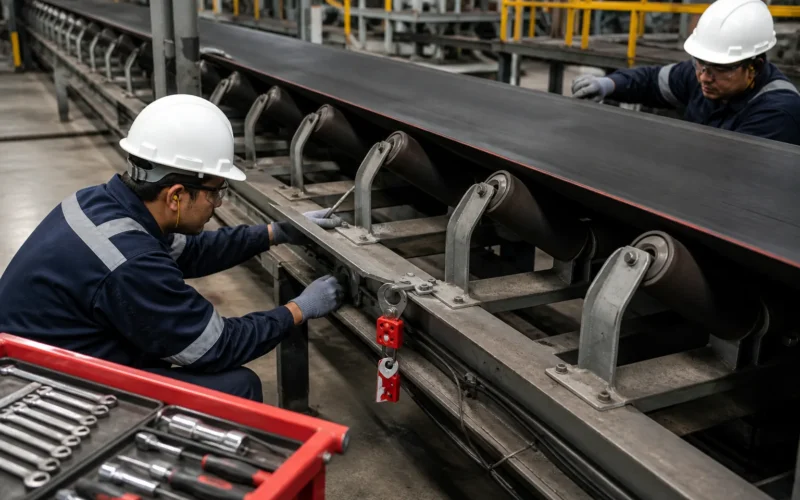
A good conveyor routine has three layers — quick daily looks, deeper periodic checks, and a thorough annual service. Here is what belongs in each.
Daily (a few minutes, by the operator):
Weekly and monthly (by a technician):
Yearly (a full service):
The exact intervals depend on how hard your line works. A conveyor running one shift a day in a clean environment needs less frequent attention than one running around the clock in a dusty or wet plant. When in doubt, check more often at first, watch how quickly things actually wear on your line, and settle into a rhythm that matches your real conditions.
A great maintenance routine still leaves you stranded if the part you need is on a boat from overseas. The single biggest cause of long conveyor downtime is not the failure itself — it is waiting for a spare. Keeping a small stock of the common wear items on the shelf turns a multi-day shutdown into a one-hour fix.
The parts worth stocking are the ones that wear predictably: rollers, drive and conveyor belts, bearings, motor and drive components, and the sensors and photo-eyes your line depends on. You do not need a warehouse of spares — just one or two of each critical, fast-wearing item, chosen with your supplier based on what actually fails on your type of line. Ask them to help you build a short, sensible spares list. It is one of the cheapest forms of insurance a factory can buy.
The best maintenance routine is the one that actually gets done, and that means making it simple and assigning it to someone. You do not need expensive software to start. A basic calendar or checklist that says who checks what, and how often, is enough to transform a line’s reliability.
Set it up in three tiers matching the checks above: a short daily card for operators at shift start, a weekly or monthly list for your technician, and a diarised annual service. Write down what was checked and any parts replaced, because that log quickly becomes valuable — it shows you which components wear fastest, helps you predict the next replacement, and lets you order parts before you need them. Over time the record turns maintenance from guesswork into something you can plan and budget with confidence.
Conveyors almost always warn you before they fail — the trick is teaching your team to notice. A few signs are worth acting on immediately rather than waiting for the next scheduled check:
Catching any of these early usually means a small, cheap fix. Ignoring them is how a five-minute job becomes a full breakdown. It is worth spending ten minutes with your operators explaining these signs, because they are the ones near the line all day and will spot trouble long before the next inspection.
Plenty of maintenance can be done in-house, and it should be — the daily and weekly checks are exactly the kind of thing your own team can own. But some jobs are worth handing to a specialist: annual servicing, drive and gearbox work, control and electrical faults, alignment problems, and anything involving the safety systems. These need the right knowledge and tools, and getting them wrong can be costly or dangerous.
For many factories the best arrangement is a maintenance contract with a specialist who knows conveyor systems, keeps a record of your line, and can respond quickly when something goes beyond routine. That gives you the reassurance of expert eyes on the line at regular intervals, plus fast help when you need it — ideally from a partner who can also supply and fit the parts, so one team is accountable for keeping you running. If your supplier also services lines from other makers, even better, because you are never left stuck with a single vendor.
How often should conveyors be serviced?
Daily and weekly checks are done in-house, while a full professional service is typically recommended once a year — more often for lines running heavy, continuous shifts or in dusty or wet conditions.
What is the most common cause of conveyor downtime?
Worn belts, rollers and bearings top the list, and the downtime is often made worse by not having the spare part on hand when the failure happens.
Which spare parts should I keep in stock?
The fast-wearing items: rollers, belts, bearings, drive components and sensors. Your supplier can help you build a short list based on your specific line.
Can I do conveyor maintenance myself?
Daily and weekly checks, yes — they are straightforward. Annual servicing, drive and electrical work, and anything touching the safety systems are best left to a specialist.
Do you service conveyors you did not install?
Yes. Experienced maintenance teams service and supply parts for conveyor lines from any manufacturer, so you are not tied to your original vendor.
At Aliran Tenaga Technology, we design, build, install and maintain industrial systems across Malaysia — all under one roof from our base in Subang Jaya, Selangor. With over 15 years of hands-on engineering, an in-house design and fabrication team, and rapid on-site support, we are one accountable partner from first idea to running line. Tell us what you need and our team replies within 24 hours with a clear, no-obligation quote.
👉 See how we can help or Request a Free Quote today.
Related reading: