7 August 2026 • Aliran Tenaga Engineering Team
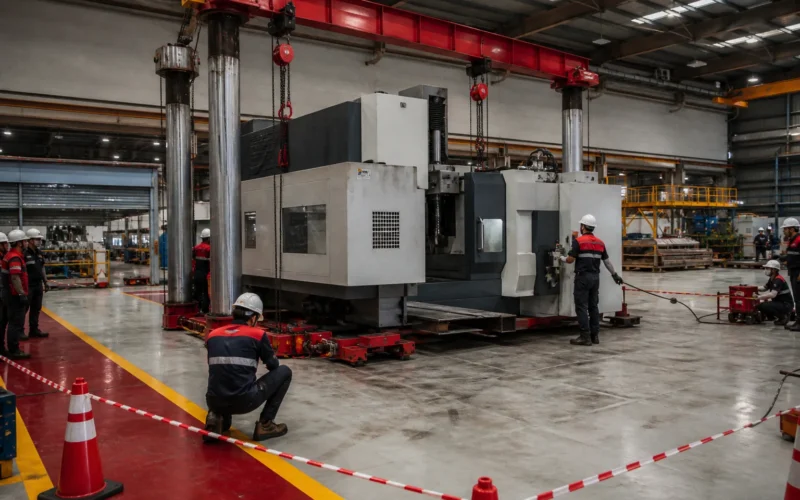
Moving a heavy machine is one of those jobs that looks simple until something goes wrong. A single press, CNC machine or production line can weigh several tonnes, cost a fortune to replace, and take weeks or months to source again if it is damaged in transit. Add a tight factory doorway, a public road, a delivery deadline and the safety of your team, and you can see why machinery relocation is a job for people who do it every day.
Whether you are shifting one machine across the floor or relocating an entire factory to a new site, this guide explains how a proper machinery relocation is planned and carried out in Malaysia — so you know what good looks like, and what questions to ask before you hand over your most valuable equipment.
Heavy machinery is deceptively difficult to move. It is often top-heavy, delicate inside, and set up to very fine tolerances. Move it carelessly and you risk cracked castings, bent shafts, damaged control electronics, and a machine that never runs quite right again — on top of the very real safety risk of shifting several tonnes of steel.
Proper relocation protects three things at once: your equipment, your people, and your production schedule. Cutting corners to save a little on the move is a false economy, because the cost of a damaged machine or an injured worker dwarfs any saving. This is precisely why experienced movers follow a disciplined, step-by-step process rather than improvising. The difference between a professional crew and a general haulier is not the truck — it is the planning, the rigging knowledge, and knowing exactly where a particular machine can and cannot be lifted.
A well-run move follows a clear sequence, and skipping steps is exactly where damage and delay creep in.
Notice how much happens before the machine even leaves the building. The survey and the plan are the quiet, unglamorous stages that decide whether the day runs smoothly or turns into a scramble. A crew that turns up without having measured your doorways and mapped the route is a crew that will improvise — and improvising with several tonnes of machinery is exactly what you are paying to avoid.
Getting a machine to the new floor is only half the job. If it is not levelled and aligned correctly, you get vibration, uneven wear, poor product quality and a shorter machine life — problems that can take months to trace back to a rushed move. Precision machines in particular need laser alignment and proper anchoring to perform the way they did before they were touched.
This quiet, careful stage is what separates a relocation that works from one that causes lingering headaches. A machine that runs smoothly, holds tolerance and lasts is the real proof that a move was done well — not simply that it arrived in one piece. It is worth asking any mover how they verify alignment at the new site, and whether they hand you the readings afterwards. A crew that measures, records and shows you the numbers is a crew that stands behind its work.
Two things trip up factory moves more than anything else. The first is customs and clearance when machinery is imported or moved across borders. Plan this early, because equipment stuck at the port helps nobody and can blow your timeline apart. The second is utilities at the new site — the electrical supply, compressed air and other services must be ready and correctly connected before the machine can run.
A capable relocation partner handles the wiring and utility hook-up so the machine is genuinely production-ready, not just parked in the right spot. It is a detail that is easy to forget in the rush of a move, and a costly one to discover on day one at the new site. The best way to avoid it is a simple readiness checklist agreed in advance: power capacity confirmed, air lines run, floor prepared and anchor points marked, all done before the machine arrives rather than after.
You can make any relocation faster, cheaper and safer by having a few things ready before you call a mover:
The more of this you can share up front, the more accurate the plan and quote will be, and the fewer surprises you will meet on the day. It also speeds up the survey, because the mover arrives already knowing roughly what they are dealing with. If you are not sure of a machine’s weight, do not guess wildly — a mover would far rather have the real figure from the nameplate or manual, because it drives the choice of crane, skates and even the transport vehicle.
Relocating an entire plant is a different scale of challenge, but the principles are the same — just applied in phases. A good partner will sequence the move so that some production keeps running while other machines are shifted, minimising the total downtime. Critical machines are often moved first or last depending on the plan, and the whole sequence is mapped out before anything is unbolted. Clear labelling, documentation and a realistic schedule are what keep a big move from turning into chaos.
It helps to think of a factory move as a relay rather than a single sprint. You want the new line coming to life as the old one winds down, so the gap where nothing is producing is as short as possible. A mover who has done full plant relocations before will talk to you in exactly these terms — which machine goes when, what has to be tested before the next one moves, and where the buffer stock sits to cover the changeover. That kind of planning is what protects your delivery commitments to your own customers while the move is under way.
How much downtime should I expect?
It depends on the machine and the distance, but a single machine move can often be done over a weekend, while a full line or factory relocation is planned in phases to keep as much production running as possible.
Do you handle dismantling and re-installation, or just transport?
A proper relocation is end-to-end — disconnection, dismantling, rigging, transport, installation, levelling, reconnection and testing — so one team is accountable for the machine arriving and running.
Can you move precision machines without affecting accuracy?
Yes. With correct handling, laser alignment and levelling at the new site, a precision machine is restored to its original running accuracy.
Do you arrange transport and customs clearance too?
Yes. End-to-end logistics including heavy-haulage transport and customs clearance for imported or relocated machinery can be handled as part of the move.
Is my machinery insured during the move?
Reputable movers carry insurance for the equipment in transit, and it is worth confirming the cover and limits in writing before work starts, so both sides are clear on what is protected.
At Aliran Tenaga Technology, we design, build, install and maintain industrial systems across Malaysia — all under one roof from our base in Subang Jaya, Selangor. With over 15 years of hands-on engineering, an in-house design and fabrication team, and rapid on-site support, we are one accountable partner from first idea to running line. Tell us what you need and our team replies within 24 hours with a clear, no-obligation quote.
👉 See how we can help or Request a Free Quote today.
Related reading: