5 August 2026 • Aliran Tenaga Engineering Team
Labour is getting harder to find and more expensive, floor space is tight, and customers want faster, more consistent delivery. For Malaysian factories and warehouses, material handling automation — moving, sorting, lifting and palletising goods with machines instead of manual labour — has shifted from a “nice to have” to a competitive necessity. But automation projects also have a reputation for going over budget and under-delivering, usually because they were bought as equipment rather than designed as a system.
This guide is a plain-English overview for factory and warehouse managers: what material handling automation actually covers, where it pays back fastest, how to avoid the common mistakes, and how to choose a partner who will design a system that fits your operation rather than force your operation to fit their catalogue.
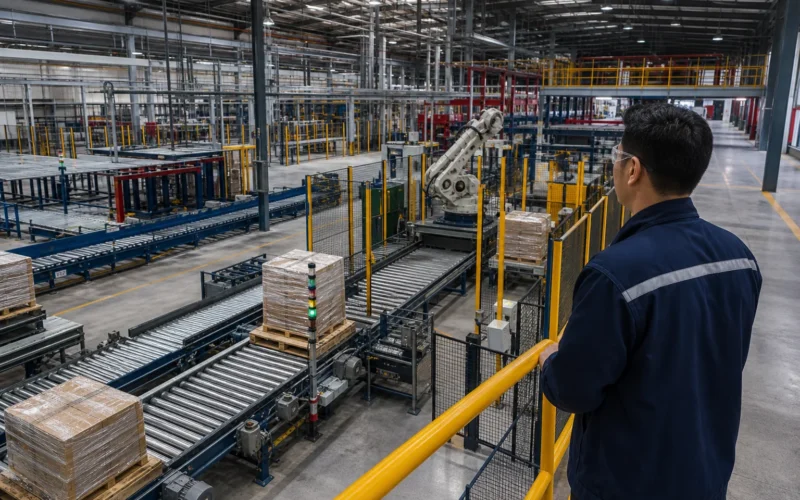
“Automation” is a broad word. In practical terms, a material handling automation project usually combines several of these building blocks:
| Building block | What it does |
|---|---|
| Conveyor systems | Move product automatically along a set path — the backbone of most lines |
| Palletising automation | Stack finished goods onto pallets — by robot or dedicated palletiser |
| Vertical lifters | Move goods between floors without forklifts or ramps |
| Robotic cells | Pick-and-place, machine tending, welding, assembly and quality tasks |
| PLC & control systems | The “brain” that coordinates everything — zone control, sensors, safety |
The value is not in any single machine — it is in how they are integrated into one coordinated flow. A material handling system that ties conveyors, lifters and robots together under one control system is worth far more than the sum of its parts.
You do not have to automate everything at once. The best return usually comes from tackling the specific points that hurt most:
The smart approach is to identify the one or two operations that cost the most in labour, damage or delay, automate those first, and design the system so it can grow later.
Most disappointing automation projects fail for the same handful of reasons — all avoidable:
Automation cost scales with scope — from a simple conveyor upgrade to a full automated line with robotics and warehouse-system integration. Because the investment can be significant, it is worth knowing that Malaysian programmes may help fund it: the Smart Automation Grant (SAG) through MIDA, the Investment Tax Allowance (ITA) on qualifying capital expenditure, and the Industry4WRD Intervention Fund through MITI for SMEs adopting Industry 4.0 technologies. Eligibility and amounts change, so confirm current terms with MIDA and MITI, and ask your automation partner to help prepare the technical documentation these applications require.
The single biggest factor in a successful project is whether one accountable team owns the whole thing — design, fabrication, electrical, controls and after-sales — or whether it is split across vendors who blame each other when something does not line up. Look for a partner with genuine in-house engineering across mechanical, electrical and controls; the ability to design and simulate before building; and fast local support afterwards. A partner who can handle conveyors, lifters, robotics and the control system under one roof removes the integration risk that sinks so many projects.
Aliran Tenaga Technology designs, builds, installs and maintains industrial systems across Malaysia from our base in Subang Jaya, Selangor. With over 15 years of hands-on engineering and an in-house design and fabrication team, we deliver material handling systems, industrial automation and robotic solutions as one integrated system — plus the electrical and PLC control underneath it. One accountable partner, from first idea to running line.
Do I have to automate everything at once?
No. The best approach is usually to automate the one or two operations that cost the most in labour, damage or delay first, and design the system so you can add to it later.
What is the quickest automation win for most factories?
Automating repetitive point-to-point moving (with conveyors or pallet handling) and palletising are common fast wins, because they remove heavy, repetitive manual work.
How do I avoid an automation project going over budget?
Buy a designed system, not loose equipment; insist on flow simulation before building; size for growth; and use one accountable integrator rather than several vendors.
Can automation be funded by a grant?
Possibly — programmes such as the Smart Automation Grant, Investment Tax Allowance and Industry4WRD may support it. Confirm current eligibility with MIDA and MITI.
What if my product or floor is unusual?
That is exactly where custom design matters. A good integrator designs around your product and space rather than forcing a standard system to fit.
Tell us where your operation hurts most, and our team replies within 24 hours with a clear, no-obligation quote. 👉 See our automation solutions or Request a Free Quote today.