9 August 2026 • Aliran Tenaga Engineering Team
If your operation runs across more than one floor — a mezzanine store above the production area, a two-storey warehouse, a packing level above dispatch — then moving goods up and down is one of your biggest hidden costs. Most factories solve it with a forklift and a ramp, or worse, with people carrying boxes up stairs. Both are slow, both are expensive, and both are a safety incident waiting to happen.
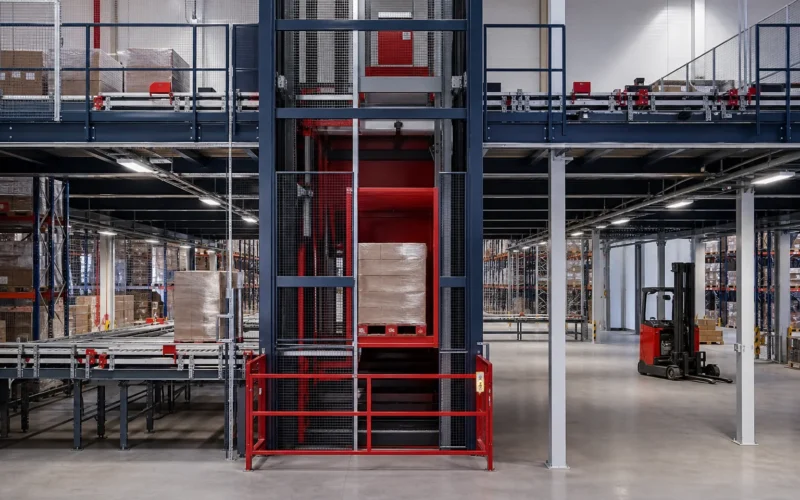
A pallet lifter, also called a goods lift or vertical conveyor, solves this quietly and cheaply. It moves pallets and goods safely between floor levels, freeing up your forklift, your floor space and your people. This article explains what a pallet lifter actually does, where the savings come from, and how to tell whether your facility is a good fit.
A pallet lifter is a fixed vertical unit that raises and lowers loads between two or more levels. You load a pallet or goods onto the platform on one floor, it lifts to the level you want, and it is unloaded there. It is purpose-built for goods — not people — which makes it simpler, cheaper and more compact than a passenger lift, while still being fully guarded and safe.
Think of it as the vertical version of a conveyor. Where a conveyor moves goods horizontally across the floor, a pallet lifter moves them up and down between floors. It can stand alone, with staff loading and unloading by pallet jack, or it can be built into a conveyor line so pallets arrive, ride up automatically, and continue on the next level with no one touching them. That flexibility is what makes it such a useful building block in a multi-level operation.
The value of a pallet lifter is easy to see once you add up what it replaces. The savings come from several directions at once:
For many facilities, the labour and forklift savings alone pay back the cost of the lifter within a couple of years — and everything after that is money in your pocket, plus a much safer operation. It is worth doing the sum for your own site: count how many vertical trips happen in a day, multiply by the time each one takes, and you quickly see how much productive capacity is being burned on moving things up and down.
Pallet lifters come in a few forms, and the right one depends on your loads and how often you use it:
The right choice depends on your load weight, how many moves per hour you need, and how many levels you are serving. A good supplier will size the lifter to your real throughput and loads rather than selling you more capacity than you will use — or, just as bad, a unit that becomes a bottleneck the moment you get busy.
It also helps to think ahead about how the lifter will be loaded and unloaded. Will staff bring pallets to it with a hand jack, or will a conveyor feed it automatically? Do both floors have enough clear space around the lifter for the load to be moved on and off without a scramble? These small details decide how smoothly the lifter fits into your daily flow, and they are much easier to get right at the design stage than to fix afterwards. A short conversation with an engineer about your everyday routine at each level often shapes the design as much as the weight and throughput numbers do.
People sometimes ask why they cannot just use a passenger lift, or an existing service lift, to move goods. The answer is that goods lifters and passenger lifts are built to different rules and for different jobs. A pallet lifter is designed and certified specifically for goods, which makes it more robust for repeated heavy loading, more compact, and considerably more cost-effective for the job of moving pallets all day.
Using a passenger lift for constant goods handling wears it out faster, ties up a lift your people need, and often is not rated for the loads or the duty cycle. A purpose-built pallet lifter is the right tool: rated for the weight, built for continuous use, and cheaper to buy and run for this specific task. It also keeps your goods flow and your people flow separate, which is safer and less disruptive for everyone.
Because a pallet lifter moves heavy loads between levels, safety is designed into it from the start rather than added as an afterthought. A properly built unit includes full guarding and enclosures so no one can reach into the lift path, interlocked gates or doors at each level that prevent operation unless everything is closed, and overload protection that stops the lifter taking more than it is rated for.
It will also have emergency stops, and controls positioned so the operator is clear of the load. These features are not extras to trim from the quote — they are what makes the machine safe to run every day. When comparing suppliers, check that the safety systems are comprehensive and properly certified, because a cheap lifter that skimps on guarding is a false economy that puts your people at risk.
A pallet lifter is worth serious consideration if any of these sound like you: you run production or storage across two or more levels; you use a forklift and ramp to move goods between floors; your team carries stock up and down stairs; your ramp is eating floor space you would rather use for something else; or you have had near-misses or injuries moving loads between levels.
Even a single vertical lifter can transform the flow of a multi-level operation — and if you are already planning a conveyor line, building a lifter into it makes the whole system flow from floor to floor with no manual handling at all. The best way to know is a quick site visit: an engineer can look at your levels, your loads and your throughput and tell you honestly whether a lifter will pay for itself, and which type suits your building. Often the answer is yes, and the payback is faster than owners expect.
How much weight can a pallet lifter handle?
It depends on the model, but units are commonly built to handle standard loaded pallets and can be specified for heavier loads. The lifter is sized to your specific loads during design.
Can a pallet lifter be built into my existing conveyor line?
Yes. A vertical lifter can be integrated so pallets arrive, ride up or down automatically, and continue on the next level with no manual handling.
Is it cheaper than a passenger lift?
For moving goods, yes — a purpose-built goods lifter is more compact, more robust for heavy repeated loading, and considerably more cost-effective than adapting a passenger lift.
How much floor space does it need?
Far less than a forklift ramp. A vertical lifter has a small footprint, which is one of the main reasons facilities switch to one.
How long does installation take?
A standalone goods lift can often be installed and commissioned quickly, while a unit integrated into a full automated line takes longer. Your supplier will give a clear timeline after a site survey.
At Aliran Tenaga Technology, we design, build, install and maintain industrial systems across Malaysia — all under one roof from our base in Subang Jaya, Selangor. With over 15 years of hands-on engineering, an in-house design and fabrication team, and rapid on-site support, we are one accountable partner from first idea to running line. Tell us what you need and our team replies within 24 hours with a clear, no-obligation quote.
👉 Engineering and automation solutions for Malaysian industry. Specialists in conveyor systems, PLC automation, robotics, electrical engineering, and heavy machinery services. No. 7, Jalan Nilam 2, Taman Perindustrian Teknologi Tinggi, 47500 Subang Jaya, Selangor
Our Services
Material Handling System
Industrial Automation
Robotic Solutions
Electrical & Electronics
Logistics & Machine Moving
Stamping PressContact