13 August 2026 • Aliran Tenaga Engineering Team
In a busy warehouse, the humble pallet is the unit that everything moves in — and moving pallets is where a huge amount of forklift time, labour and product damage quietly disappears. A palletized conveyor system tackles this head-on by moving loaded pallets automatically through your warehouse or production line, replacing a good chunk of forklift trips with a steady, hands-off flow.
If you are weighing up whether a palletized conveyor is right for your operation, this buyer’s guide walks you through the essentials: what it does, the first big choice between chain and roller, how to size it for your loads, where the return on investment comes from, and why integration is where these systems really earn their keep.
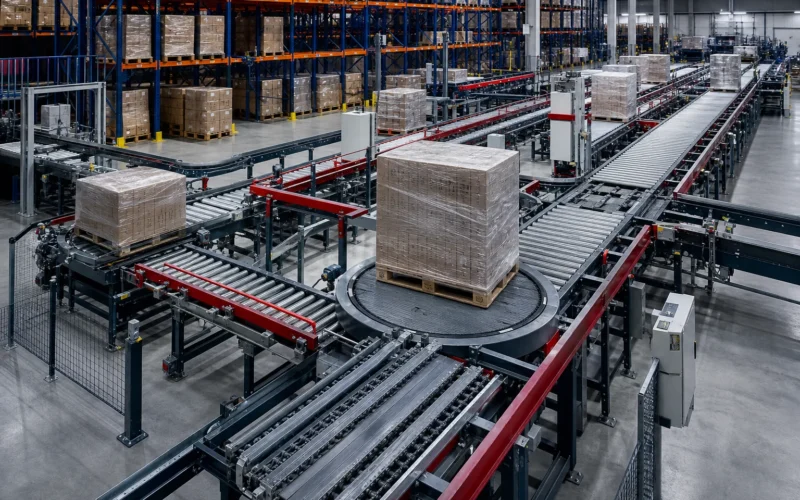
A palletized conveyor is a heavy-duty system built specifically to handle loaded pallets — not cartons or loose items, but full pallets that can weigh anywhere from a few hundred kilograms to well over a tonne. It moves them automatically along a set path: from goods-in to storage, from production to wrapping, from one area of the warehouse to another, without a forklift making every trip.
Because pallets are heavy and the system runs continuously, everything about it is built tough — strong frames, heavy-duty rollers or chains, and motors sized for the load. It is the backbone of an automated warehouse flow, and it is what lets you move large volumes of palletised goods reliably without tying up drivers and forklifts on repetitive point-to-point runs. Think of it as a fixed highway for your pallets, doing the predictable, repetitive moves so your people and forklifts are free for the work that actually needs them.
The first real choice you will make is between chain and roller, and it comes down to your pallets and your layout. Both are proven; they simply suit different situations.
Many real systems use both — chain where pallets need to move across the direction of travel or where loads are heaviest, and roller for the main runs and accumulation zones. The right mix depends on your pallet quality, your weights, and how the pallets need to move through the space. A good supplier will look at an actual sample of your pallets before recommending one, because pallet condition alone can decide the answer.
Getting the sizing right is what separates a system that serves you for years from one that struggles or over-costs you. A few numbers drive the whole design, and it is worth having them clear before you talk to a supplier:
Give your supplier honest peak numbers rather than hopeful ones. Undersize the system and it becomes a bottleneck when you get busy; oversize it and you pay for capacity you will not use. A well-sized palletized conveyor handles your busiest hour comfortably and has a little room to grow — that balance is exactly what a good design delivers.
One detail that is easy to overlook at the sizing stage is your pallets themselves. Broken boards, protruding nails, warped bases and a mix of pallet sizes all affect how reliably a system runs, and a conveyor sized only on weight and throughput can still jam if it is fed poor-quality pallets. It is worth showing your supplier a genuine sample of the pallets you use day to day, including the worst ones, so the system is designed for reality rather than for a perfect pallet you rarely see. Standardising your pallet pool where you can will also make the whole system run more smoothly for years.
A palletized conveyor is a serious investment, so it is fair to ask where the money comes back. The return builds from several directions at once, and for a busy warehouse it adds up quickly:
For a warehouse moving a lot of pallets, the labour and forklift savings alone often justify the system within a few years, and the reduction in product damage and accidents is a bonus that keeps paying. It is worth counting your daily pallet moves and the forklift time they consume — the number is usually bigger than owners expect, and it makes the case for automation clear.
A palletized conveyor is useful on its own, but it becomes genuinely powerful when it is integrated with the rest of your operation. On its own it moves pallets from A to B. Tied into your other equipment and systems, it becomes part of a flow that runs with very little manual handling at all.
It can feed a stretch wrapper automatically, connect to a vertical lifter to move pallets between floors, hand off to and from production lines, and link with your warehouse systems so pallets flow through the operation in a coordinated way. This is where automation stops being a single machine and becomes a system — and it is why it pays to work with a supplier who understands the whole picture, not just the conveyor. The hand-off points between the conveyor and everything around it are where good integration shows, and where a supplier who only knows conveyors will leave gaps that cost you manual handling.
Palletized conveyors are often asked to run continuously, shift after shift, carrying heavy loads — so they must be built for that duty from the start. This is not equipment where cutting corners on materials or motors pays off; a system that fails under continuous heavy load costs you far more in downtime than it ever saved on price.
Look for robust construction, quality drive components, and a design that makes maintenance straightforward so wear parts can be checked and replaced without long shutdowns. Just as important is the after-sales support behind it: for a system your operation depends on around the clock, you want a partner who can respond quickly and get you spare parts fast. A well-built palletized conveyor from a supplier who stands behind it will run reliably for many years, which is exactly what a warehouse backbone needs to do.
How heavy a pallet can a palletized conveyor handle?
These systems are built for heavy loads and are sized to your specific pallet weights during design, comfortably handling standard loaded pallets and heavier where needed.
Should I choose chain or roller?
It depends on your pallet weight, pallet condition and layout. Chain suits the heaviest loads and poorer-condition pallets; roller suits good pallets, accumulation and more complex layouts. Many systems use both.
Can it connect to my stretch wrapper and other equipment?
Yes. Integration with wrappers, lifters, production lines and warehouse systems is one of the main advantages of a palletized conveyor.
Will it really reduce my forklift use?
For repetitive point-to-point pallet moves, yes — the conveyor handles those automatically, freeing forklifts and drivers for other work and often reducing how many you need.
Is it worth it for a smaller warehouse?
It depends on your pallet volume. A site visit lets an engineer assess your throughput and layout and tell you honestly whether the return justifies the investment for your operation.
At Aliran Tenaga Technology, we design, build, install and maintain industrial systems across Malaysia — all under one roof from our base in Subang Jaya, Selangor. With over 15 years of hands-on engineering, an in-house design and fabrication team, and rapid on-site support, we are one accountable partner from first idea to running line. Tell us what you need and our team replies within 24 hours with a clear, no-obligation quote.
👉 See how we can help or Request a Free Quote today.
Related reading: