6 August 2026 • Aliran Tenaga Engineering Team
Walk into almost any warehouse in the Klang Valley today and you will hear the same complaints from the people running it. Workers are hard to find and harder to keep. Rental per square foot keeps climbing. E-commerce customers expect same-day dispatch. And every peak season turns into a scramble of overtime, errors and near-misses on the floor. If any of that sounds like your operation, you have probably already had the thought: maybe it is time to automate.
But “warehouse automation” is one of those phrases that means everything and nothing. To one supplier it means a couple of powered conveyors. To another it means a fully robotic, lights-out distribution centre worth millions. So before you spend a single ringgit, it helps to understand what warehouse automation actually covers, which parts make sense for a Malaysian operation your size, where the money comes back, and how to avoid the expensive mistakes that give automation a bad name.
This guide walks through all of that in plain language — no jargon for the sake of it — so you can have a smarter conversation with any supplier who quotes you.
A few years ago, automating a warehouse in Malaysia was mostly a big-multinational thing. Labour was cheap, land was cheaper, and the sums rarely worked for a small or mid-sized operation. That has changed, and fast.
The first driver is labour. Anyone who has tried to hire warehouse staff recently knows how tight it has become — high turnover, rising wages, and a real dependence on foreign workers whose availability can change overnight with policy. When your whole operation rests on people who might not be there next quarter, that is a business risk, not just an HR headache.
The second is space. Industrial rental in the Klang Valley, Penang and Johor has been on a steady climb, driven partly by the data-centre and manufacturing boom. When floor space costs this much, storing goods inefficiently is literally throwing money away. Automation — especially vertical storage — lets you hold far more stock in the same footprint.
The third is e-commerce. Malaysian shoppers now expect fast, accurate delivery as standard. That pressure flows straight back to the warehouse: more orders, smaller order sizes, tighter dispatch windows, and zero tolerance for picking the wrong item. Manual processes that coped fine five years ago simply cannot keep up.
Put those three together and you get the reason automation enquiries have exploded. It is no longer about replacing people for the sake of it — it is about staying competitive when the old way of running a warehouse has stopped working.
Think of warehouse automation as a spectrum, not a single product. At the simple end you have a couple of powered conveyors moving boxes from goods-in to packing. At the far end you have a fully automated distribution centre where goods are stored, retrieved, sorted and dispatched with barely a human hand involved. Most Malaysian operations sit somewhere in between, and the smart ones automate in stages rather than all at once.
Here are the main building blocks you will come across, and what each one actually does.
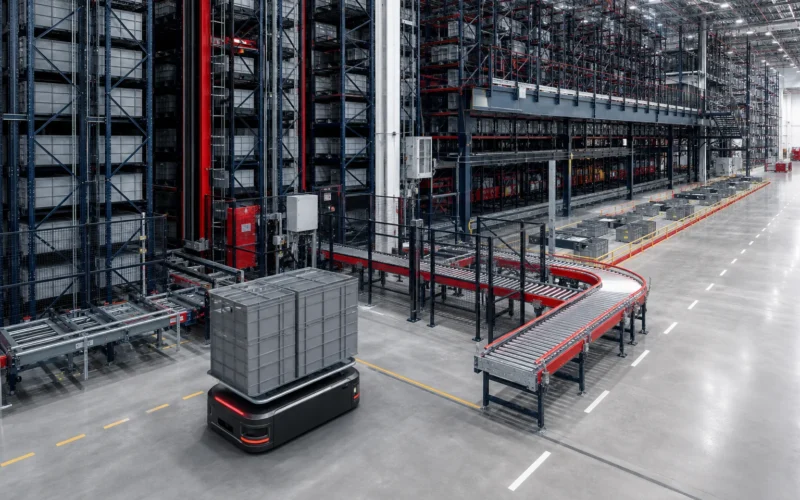
Conveyors are the backbone of nearly every automated warehouse — the “roads” that goods travel on. In a warehouse context they do more than just move boxes in a straight line. Add sensors and controls and a conveyor line can accumulate goods without crashing them together, merge two streams into one, and divert items down different lanes automatically. That last part — sortation — is where the magic happens for e-commerce fulfilment: a scanner reads each parcel and a diverter pushes it to the right chute for its destination, hundreds of times an hour, without a person deciding each one.
If you are only going to automate one thing first, a well-designed conveyor and material handling system is usually where the fastest, most reliable return lives. It is proven technology, it does not need a lot of babysitting, and it removes the most tiring, repetitive walking and carrying from your floor.
Warehouses grow upwards long before they grow outwards, especially when land is expensive. The moment you have a mezzanine or a second storage level, you have a movement problem: how do you get pallets and goods between floors safely and quickly? Using a forklift on a ramp eats space and is a genuine safety risk. A vertical goods lifter solves it cleanly, moving loads between levels on a small footprint. It is one of the least glamorous pieces of automation and one of the most quietly valuable.
ASRS is the big one people picture when they hear “automated warehouse” — tall racking with machines (cranes or shuttles) that store and retrieve goods automatically, with no human going up and down the aisles. The appeal is density: because the machines are precise and do not need wide aisles for a person to walk, you can store far more in the same building, sometimes several times more. ASRS also all but eliminates picking errors and lets you run in the dark, cold or otherwise unpleasant environments that people struggle in.
ASRS is a serious investment and it is not for everyone. It suits operations with high, predictable volumes and stable product ranges. If your stock changes constantly or your volumes are modest, a simpler mix of conveyors and good racking often gives a better return. A good integrator will tell you honestly whether you are an ASRS candidate or not, rather than selling you the biggest system they can.
Automated Guided Vehicles (AGVs) and Autonomous Mobile Robots (AMRs) are the robots that move goods around the floor without a driver. The difference matters. An AGV follows a fixed path — usually a magnetic strip or markers on the floor — so it is reliable but rigid; change the route and you have to change the infrastructure. An AMR is smarter: it uses onboard sensors and mapping to navigate freely, avoid obstacles and re-route on the fly, which makes it far more flexible in a busy, changing warehouse.
Mobile robots shine where goods need to travel long or variable distances — bringing shelves to a picker, moving pallets between zones, feeding a production line. They are a growing part of Malaysian warehouses, though they work best as one piece of a designed system rather than a gadget bought in isolation.
Stacking finished goods onto pallets is heavy, repetitive, and one of the most common causes of back injuries on a warehouse floor. A palletising robot does it tirelessly, to a consistent pattern, around the clock. Because it is such a clearly defined, repetitive task, robotic palletising is often one of the quickest automation wins with the clearest payback. It pairs naturally with conveyors feeding the robot and with your wrapping and dispatch line. Aliran Tenaga covers this as part of its robotic solutions.
None of the hardware above is worth much without software telling it what to do. A Warehouse Management System (WMS) is the brain that knows what stock you have, where it is, and what needs to happen. A Warehouse Control System (WCS) is the layer that translates those decisions into instructions for the conveyors, sorters, ASRS and robots. When people say an automation project “failed”, the cause is very often the software integration, not the machines. Getting the control layer right — and making it talk properly to your existing systems — is where experienced integrators earn their fee.
You do not need every warning sign to justify automation, but if several of these ring true, it is worth getting a proper assessment:
Notice that most of these are about cost, risk and capacity — not about wanting shiny robots. That is the right way to think about it. Automation is a tool to solve a specific business problem, and the best projects start by naming the problem clearly.
Automation is a capital investment, so the fair question is always: where does the money come back? For most Malaysian operations, the return builds from several directions at once.
Labour. The most obvious one. Fewer people doing repetitive moving and carrying, and less exposure to the hiring and turnover problem. Importantly, this is rarely about sacking staff — most operations redeploy people to higher-value work like quality checks, supervision and customer service, which is a much better use of a wage.
Space. Vertical storage and denser layouts mean you hold more in the same building — often deferring an expensive move or expansion by years. When you price automation against the cost of renting or building a bigger warehouse, the sums often look very different.
Accuracy. Every wrong item shipped costs you twice — the return logistics and the customer trust. Automated picking and sortation cut error rates dramatically, and in an e-commerce world that protects both margin and reputation.
Safety. Fewer forklift movements, less manual lifting, and fewer people in harm’s way. Beyond the human cost, workplace incidents carry real financial and compliance consequences under Malaysian occupational safety law overseen by DOSH. Removing the riskiest manual tasks is money and duty of care at the same time.
Throughput and consistency. A machine runs at the same pace at 3 a.m. as it does at 9 a.m. That predictability lets you commit to tighter dispatch windows and handle peaks without the usual scramble.
There is no single price for warehouse automation because the scope varies so wildly. A couple of powered conveyor lines is a modest investment; a full ASRS distribution centre runs into the millions. That is exactly why automating in stages makes sense — solve your biggest bottleneck first, prove the return, then expand.
What many Malaysian manufacturers and logistics operators do not realise is that a chunk of the cost can be supported by government programmes. The Smart Automation Grant (SAG), administered through the Malaysian Investment Development Authority (MIDA), is designed to help companies co-fund automation and digitalisation, typically on a matching basis. There is also the Investment Tax Allowance on qualifying capital expenditure, and the Industry4WRD initiative through MITI supporting Industry 4.0 adoption among SMEs.
Eligibility, ceilings and application windows change from year to year, so always confirm the current terms directly with MIDA and MITI before you budget. The practical tip: choose an automation partner who has helped clients with these applications before and can prepare the technical documentation they require. It can meaningfully change the maths on your project. We cover this in more detail in our guide to material handling automation in Malaysia.
Automation gets a bad reputation from the projects that go wrong, and they almost always go wrong for the same handful of reasons. Knowing them in advance is half the battle.
Buying equipment instead of a system. The classic mistake is treating automation like a shopping list — a conveyor from here, a robot from there, software from somewhere else — with nobody accountable for making them work together. The gaps between components are where jams, errors and finger-pointing live. One team owning the whole integration is worth more than the cheapest quote on each part.
Skipping the simulation. A serious integrator will model your flow on a computer before building anything — proving it hits your target throughput and finding the bottlenecks while they are still cheap to fix on screen. If a supplier cannot show you the line running as a simulation, be cautious.
Automating a bad process. If your current workflow is messy, automating it just makes the mess faster and more expensive. The best projects start by simplifying and fixing the process, then automating the clean version.
Under-sizing for growth. Building a system that only handles today’s volume means it becomes a bottleneck the moment business grows. A little designed-in headroom is cheap now and priceless later.
Ignoring after-sales. An automated line that stops on a Sunday night needs a local team who can be on-site fast. A brilliant system with no local support is a liability. Always ask who answers the phone when it breaks, and how quickly they arrive.
The single biggest factor in whether your project succeeds is who you choose to deliver it. Look past the sales brochure and check for a few concrete things. Do they have genuine in-house engineering across mechanical, electrical and controls — or do they subcontract the hard parts? Can they design and simulate before building? Do they have a real track record with named projects you can look at? And crucially, can they support and service the system quickly once it is running?
There is a strong case for choosing a partner who can handle the whole picture — conveyors, lifters, robotics and the electrical and control systems underneath — rather than stitching together several vendors. It removes the integration risk that sinks so many projects, and it gives you one number to call when something needs attention. If you want a deeper checklist, our guide on choosing a conveyor supplier in Malaysia applies just as well to automation partners.
It is tempting to assume the biggest global automation brand is automatically the safest choice. For premium components — the robots, the drives, the sensors — international brands are often excellent. But for the system — the design, installation, integration and ongoing support — a local Malaysian partner has real advantages that show up exactly when you need them.
A local integrator understands Malaysian operating conditions, from the heat and humidity to the realities of the local labour market and the way local factories actually run. They can be on-site during installation and when problems arise, rather than routing support through a foreign time zone. They understand the local supply chain for spares. And they know the government funding landscape — the grants, allowances and the documentation that goes with them. When your line is down and every hour costs you money, “local and accountable” beats “big and far away” every time.
Malaysia’s position helps too. The Klang Valley’s proximity to Port Klang, the manufacturing density in Selangor, Penang and Johor, and the surge in e-commerce and data-centre-driven logistics all mean the ecosystem for warehouse automation here is maturing quickly. The expertise is available locally — the trick is choosing a partner who has genuinely earned it.
If there is one piece of advice to take from all of this, it is this: you do not have to automate everything at once, and you probably should not. The most successful operations pick the one or two points that hurt most — the worst bottleneck, the most injury-prone task, the biggest error source — automate those first, prove the return, and then expand from a position of confidence. Design the first phase so it can grow, and each later phase gets easier and cheaper to justify.
That staged approach also keeps the risk manageable. A focused first project that clearly pays back builds trust across your organisation and gives you the data to make the next investment with your eyes open.
Aliran Tenaga Technology designs, builds, installs and maintains industrial systems across Malaysia — all under one roof from our base in Subang Jaya, Selangor. With over 15 years of hands-on engineering, an in-house design and fabrication team, and rapid on-site support, we deliver material handling and conveyor systems, industrial automation and robotic solutions as one integrated system, with the electrical and PLC control layer built in. One accountable partner, from the first walk-through of your warehouse to the day the line is running — and every service call after.
How much does warehouse automation cost in Malaysia?
There is no single figure — it depends entirely on scope. A couple of powered conveyor lines is a modest, fast-payback investment, while a full ASRS distribution centre runs into the millions. The smart approach is to automate your biggest bottleneck first, prove the return, and expand in stages. A proper site assessment gives you a real number for your operation.
Do I have to automate the whole warehouse at once?
No, and it is usually a mistake to try. The best results come from tackling the one or two operations that cost the most in labour, errors or safety risk first, then growing from there. Design the first phase so it can expand later.
What is the difference between an AGV and an AMR?
An AGV follows a fixed path (like a magnetic strip on the floor), so it is reliable but rigid. An AMR uses onboard sensors and mapping to navigate freely, avoid obstacles and re-route itself, which makes it far more flexible in a busy, changing warehouse.
Is ASRS right for my warehouse?
ASRS suits operations with high, predictable volumes and fairly stable product ranges, where storage density and accuracy matter most. If your stock changes constantly or your volumes are modest, a simpler mix of conveyors and good racking often gives a better return. A good integrator will tell you honestly either way.
Can automation be funded by a government grant?
Possibly. Programmes such as the Smart Automation Grant (SAG) through MIDA, the Investment Tax Allowance, and Industry4WRD through MITI may support part of the cost. Terms change yearly, so confirm current eligibility with MIDA and MITI, and choose a partner who can help with the technical documentation.
Will automation mean laying off my workers?
In most cases, no. Malaysian operations typically redeploy staff from repetitive moving and carrying to higher-value work — quality control, supervision, customer service — while automation absorbs the growth and the tasks that are hardest to hire for. It is usually about capacity and safety, not headcount cuts.
How long does a warehouse automation project take?
A focused first phase — say a conveyor and sortation line — can be designed, built and commissioned in a matter of weeks. A large, fully integrated system with ASRS and software takes longer, often several months, because the design, simulation and integration are where the value is protected. A good partner gives you a clear timeline up front.
Tell us what your warehouse is struggling with — space, labour, errors, or peak-season chaos — and our team replies within 24 hours with a clear, no-obligation assessment. 👉 See our material handling & automation solutions or Request a Free Quote today.