9 September 2026 • Aliran Tenaga Engineering Team
Walk onto any modern factory floor in Malaysia and the machines you can see, the conveyors, the robots, the presses, the packing lines, are only half the story. The other half is invisible: the control system that tells every one of those machines what to do, when to do it, and what to do when something goes wrong. Get that control layer right and a plant runs smoothly, predictably and safely. Get it wrong, or neglect it, and you get the mystery stoppages, the finger-pointing and the “nobody knows why it does that” problems that quietly eat into output every week.
At the heart of that control layer sit two things that plant managers hear about constantly but are rarely given a straight explanation of: the PLC and SCADA. This guide fixes that. In plain language, it explains what a PLC is, what SCADA adds on top, how they fit together with the rest of your equipment, when it is worth upgrading your control system, and how to choose a partner who will build you something reliable rather than a black box only they understand.
A PLC, or Programmable Logic Controller, is a rugged industrial computer built to do one job extremely well: read inputs, make decisions, and switch outputs, thousands of times a second, for years on end, in the heat, dust and vibration of a factory. It is the brain that sits behind a machine or a line.
Think of it in three parts. It takes in inputs: signals from sensors, switches, photocells, temperature probes and buttons that tell it what is happening in the real world. It runs a program: a set of logic rules an engineer has written, of the form “if this sensor is on and that guard is closed, then start the motor.” And it drives outputs: it energises motors, valves, actuators, lights and alarms to make the machine act. A PLC does this loop continuously and deterministically, which is the crucial word, it does the same thing in the same time every cycle, which is what makes automated machinery safe and repeatable.
The reason PLCs, rather than ordinary PCs, run factories is reliability. A normal computer is not built to sit next to a stamping press for a decade, and it is not built to react in guaranteed time. A PLC is. It is the difference between a machine that does exactly what it is told, every cycle, and one that occasionally hangs at the worst possible moment. Everything Aliran Tenaga builds, from a single conveyor to a full automated line, has this kind of PLC and control system underneath it, because without it the mechanical hardware is just metal.
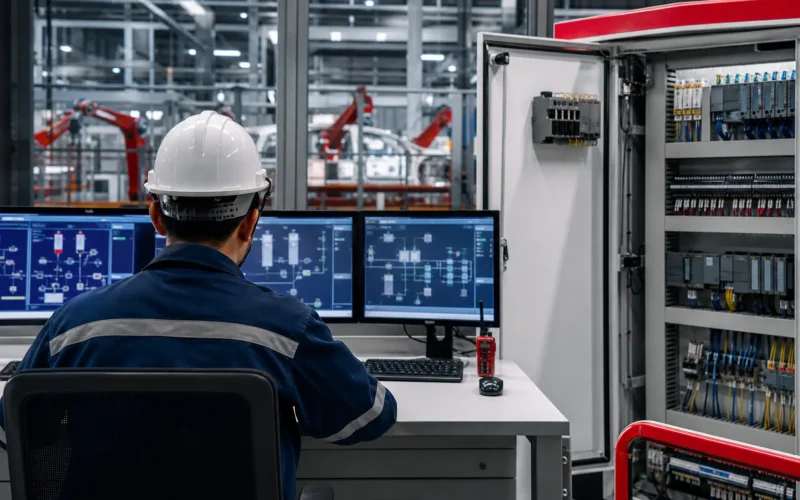
If the PLC is the brain of a machine, SCADA is the control room for the whole plant. SCADA stands for Supervisory Control and Data Acquisition, and while the name is a mouthful, the idea is simple: it is the layer that lets people see and supervise everything the PLCs are doing, from one place.
A single PLC controls its machine perfectly well on its own. But a factory has many PLCs, on many machines, across a large floor, and a manager cannot stand next to each one. SCADA pulls all of that together. It gathers data from every PLC, shows it on screens as live dashboards and plant diagrams, records it over time, raises alarms when something goes out of range, and lets an operator take supervisory control, starting a line, changing a set-point, acknowledging a fault, without walking to the machine.
The practical value shows up in three ways. First, visibility: at a glance you can see what is running, what has stopped, and where the bottleneck is right now. Second, data: SCADA logs production counts, downtime, temperatures and cycle times, which turns “I think line two is slow” into “line two lost forty minutes to the same fault three times this week.” Third, faster response: alarms tell you about a problem the moment it starts, often before it becomes a stoppage. For a plant manager trying to run a tight operation, that combination of seeing, recording and reacting is what moves a factory from firefighting to actually being managed.
PLC and SCADA do not exist in isolation. They are two levels of a stack that runs from the physical machine up to the business, and understanding the whole stack helps you see where your gaps are.
| Layer | What lives here | Its job |
|---|---|---|
| Field devices | Sensors, motors, valves, drives | Sense and act in the physical world |
| Control (PLC) | PLCs and safety controllers | Run the machine logic in real time |
| Supervision (HMI/SCADA) | Touchscreens and control-room software | Let people see and supervise the process |
| Operations (MES) | Manufacturing execution systems | Track orders, quality and production |
Most Malaysian factories are strong at the bottom two layers, they have machines with PLCs, and weaker as you go up. The HMI, the touchscreen on the machine, is really a small, local slice of SCADA: it shows one machine’s status and lets an operator control it. Full SCADA extends that idea across the whole plant. MES sits above SCADA and connects the shop floor to the business, matching production to orders and quality records. You do not need every layer on day one; the point is to know which layer your current pain lives in, so you invest in the right place rather than buying technology you will not use.
Control systems rarely fail dramatically. They just quietly stop being good enough as the plant grows, and the symptoms are easy to recognise once you know to look for them.
You are relying on one person who “knows the machine” and the plant is nervous whenever they are on leave. Downtime is a mystery, you know a line stopped, but not why, or for how long, because nothing records it. Faults take too long to find, because an operator has to physically inspect the machine to work out what tripped. Different machines from different eras cannot talk to each other, so you have islands of automation with no overall picture. And you cannot answer a simple management question, how many units did we make last shift, and where did we lose time, without someone counting by hand. Any one of these is a sign the control and supervision layer needs attention. Several together mean it is holding the whole operation back.
A common worry is that improving control means ripping out working machinery. Usually it does not. There are two broad paths, and a good controls partner will tell you honestly which fits.
Retrofitting means upgrading the control system on existing machines, adding or replacing PLCs, fitting modern HMIs, and connecting everything to a new SCADA layer, while keeping the mechanical equipment you already have. For plants with sound machines but ageing or fragmented controls, this is often the highest-return move, because it modernises the brain without replacing the body. Building new makes sense when the equipment itself is at the end of its life, or when a new line is going in, in which case the control system is designed in from the start as one coherent architecture rather than stitched together later. Aliran Tenaga does both, and the right answer always comes from looking at your actual machines and your actual pain, not from a preference for selling new equipment.
As control systems get more connected, giving you that valuable plant-wide visibility, they also become something that has to be protected and made safe. Two points matter for any Malaysian plant manager. First, safety: a control system that starts and stops machinery must be designed with proper safety functions, guarding, interlocks and emergency stops handled by the control layer, in line with the workplace safety expectations overseen by DOSH. This is not optional and not the place to cut corners. Second, operational technology security: a networked SCADA system should be sensibly segregated from the general office network and the open internet, so that the systems running your machines are not casually exposed. You do not need to be paranoid, but you do need a partner who designs safety and basic network hygiene in from the start rather than bolting it on later.
It is worth stepping back, because PLC and SCADA are not an end in themselves, they are the enabling layer that makes everything else work. A material handling system that moves product around your plant needs control logic to coordinate its conveyors and transfers. A robotic cell needs a PLC to tie the robot to the conveyors and safety around it. A full industrial automation project is, in large part, a control project: the machines are only as coordinated as the system running them. This is exactly why buying automation as separate machines from separate vendors so often disappoints, the control layer that should tie them into one flow is nobody’s clear responsibility. When one partner owns the controls across the whole system, the machines actually work together.
If you are planning a bigger step, our guides to warehouse automation and material handling automation in Malaysia show how the control layer underpins the whole operation, and because a control upgrade is a clear productivity investment, it is often eligible for support under schemes like the Smart Automation Grant.
It helps to know what the work actually looks like, because a good project follows a predictable shape rather than a surprise. It starts with an assessment: an engineer walks your floor, looks at the existing machines and controls, and pins down where you are losing time or visibility. Then comes design: the control architecture is drawn up, which PLCs, which HMIs, what the SCADA layer shows, and how the safety functions work, and where possible the logic is proven before anything is installed. Next is build and integration: panels are wired and programmed, machines are connected, and the SCADA screens are configured to match how your operators actually work. Then commissioning: the system is tested on the real line, tuned, and any faults ironed out under real conditions. Finally, and this is the part cheap projects skip, handover: your team is trained, and you receive the documentation, drawings and program backups that make the system yours to run and maintain. A partner who works this way gives you a project with no nasty surprises and a system you understand at the end of it.
The biggest long-term risk with any control system is being locked to a supplier who built you something only they understand. A good controls partner avoids that. Look for genuine in-house electrical and controls engineering, not a reseller who subcontracts the programming. Look for well-documented, cleanly structured programs, so that another competent engineer can understand and maintain the system, and ask directly whether you will receive the documentation and program backups. Look for a partner who handles the whole chain, the field devices, the PLC, the HMI and SCADA, and the safety, because gaps between those are where problems hide. And look for fast local support, because when a control system stops, your line stops, and a support ticket to a foreign vendor is no help at 2 a.m. A partner who ticks those boxes gives you a system you own and can rely on, not a black box.
Aliran Tenaga Technology designs, builds, installs and maintains industrial control systems across Malaysia from our base in Subang Jaya, Selangor. With over 15 years of hands-on engineering and an in-house electrical, controls and fabrication team, we deliver PLC and control solutions as the backbone of the material handling, robotic and automation systems we build, documented, maintainable, and supported quickly when you need us. One accountable partner for the machines and the brains that run them.
A few errors come up again and again with control-system projects. The first is treating controls as an afterthought, scoping the machinery in detail and leaving the PLC and SCADA as a line item, when in truth the control layer is what determines whether the machines work as a system. The second is accepting an undocumented black box, a system that works on day one but that only the original programmer can ever change, which quietly holds your plant hostage. The third is ignoring the operators, building fancy dashboards nobody on the floor was trained to use, so the visibility you paid for goes to waste. The fourth is skimping on safety and network segregation to save a little on the quote, which is a false economy that can cost far more later. A capable integrator heads all four off by designing the control system as a first-class part of the project, documenting it properly, involving your people, and building safety in from the start.
What is the difference between a PLC and SCADA?
A PLC is the industrial computer that controls a machine in real time, reading sensors and driving motors and valves. SCADA is the supervisory layer above it that gathers data from many PLCs, shows the whole plant on screens, records it, raises alarms and lets people supervise the process from one place. The PLC runs the machine; SCADA lets you see and manage the plant.
Do I need SCADA, or is an HMI enough?
An HMI is a local screen on one machine and is fine when you only need to see and control that machine. SCADA makes sense once you have several machines or lines and need a single, plant-wide view, historical data and alarms. Many plants start with HMIs and add SCADA as they grow.
Can I upgrade controls without replacing my machines?
Usually, yes. Retrofitting the control system, new PLCs, modern HMIs and a SCADA layer, on mechanically sound machines is common and often the highest-return move, because it modernises the brain while keeping the equipment you already have.
Will a new control system tie my old and new machines together?
That is exactly what a well-designed control and SCADA layer does, it connects machines of different ages and brands into one coordinated system with a single view. Doing this well is a core part of a good controls project.
Who is responsible for machine safety in a control system?
Safety functions, guarding, interlocks and emergency stops, must be designed into the control layer, in line with the workplace safety expectations DOSH oversees. A capable integrator builds these in from the start rather than treating them as an add-on.
Will I be locked to one supplier?
You should not be. Insist on well-documented, cleanly structured programs and receive the documentation and backups, so that any competent engineer can maintain the system. A good partner gives you a system you own, not a black box.
Can a control-system upgrade be grant-funded?
Often, yes. As a clear productivity improvement, upgrading control and automation is the kind of investment schemes such as the Smart Automation Grant are designed to support. Confirm current terms with MIDA, and ask your integrator to help with the technical documentation.
Tell us where your plant loses time or visibility, and our team replies within 24 hours with a clear, no-obligation assessment of your control system. 👉 See our PLC & control solutions or Request a Free Quote today.